Curiosity Science · 50 everyday habits

why we do that

You clink glasses. You yawn when someone else does. You knock on wood. Nobody ever told you why, and the reasons you think you know are mostly wrong.

  • 50 habits, two to three pages each, dip in anywhere
  • Every entry lists its sources, so you can check them
  • When the honest answer is “nobody knows”, it says so
  • A drawing for every single one
€9,99
Get the book · €9,99
182 pages · 50 entries · 50 drawings · PDF · instant download
Cover of Why We Do That
From the people behind Curiosity Science — the channel about the questions you stopped asking.
Start here

you already know the answer.
it’s wrong.

Every one of these has a tidy, satisfying, widely repeated explanation. Here is what happened when somebody actually checked.

Why do we clink glasses?
“So the wine sloshes between cups and proves nobody poisoned you.”
What the evidence saysInvented. It needs cups that ring, at a time people drank from wood and leather, and it gets trust backwards: worried cultures shared one cup. Rome hired a taster instead. Nobody knows where the clink came from, and that is the honest answer.
Why do we yawn?
“Your brain is low on oxygen and needs a big gulp of air.”
What the evidence saysTested in the 1980s and dead ever since. They gave people extra oxygen, then extra carbon dioxide, and counted. The yawning did not move at all. The best current guess is that a yawn cools your brain.
Why does your recorded voice sound wrong?
“Bone conduction adds bass, and the microphone throws it away.”
What the evidence saysNot bass. When people measured it, bone conduction wins only in a narrow band around 1 to 2 kHz. And in a blind test, people rated their own voice as more attractive than strangers did. The voice is fine. Knowing it is yours is the problem.
Why did nobody smile in old photographs?
“Exposure times were half a minute. You can’t hold a grin that long.”
What the evidence saysMostly wrong. By the 1860s a few seconds was enough in good light, and holding a pose is harder than holding a smile. The cameras were ready decades before the faces were. Something else changed.

There are fifty of these. About twenty of them end with the explanation you were taught quietly falling apart.

Ten seconds

so, do you know why?

Four questions. Pick one and the book answers immediately. No email, nothing stored, nothing sent.

Why do we knock on wood?
The answerThe tree-spirit story is Victorian folklore about folklore: an explanation invented long after the habit, by people guessing at their own ancestors. The trail runs cold. What we can date is the phrase, and it is startlingly recent.
Why do we tip?
The answerTipping was an English import, and Americans loathed it: undemocratic, feudal, a bribe. Several states banned it. Then emancipation put millions of people into service work with no wage, and the Pullman Company worked out that the customer could be made to pay it instead. That is when a gift became a wage.
Why is there a lawn in front of the house?
The answerGrass is livestock feed. A mown sweep of it in front of a house said three things: this land is mine, I do not need it to feed anything, and I pay men to walk across it with scythes so it keeps producing nothing. Its beauty is inseparable from its waste.
Why do you forget why you walked into the room?
The answerThe doorway really does it. Walking through one flushes what you were holding, and it happens in virtual rooms too, where there is no real door at all. Your memory files things by the room you were in. Leave the room, close the file.
What’s inside

fifty habits, seven corners of an ordinary day

It runs from breakfast to three in the morning. Read it in order or open it anywhere, which is how most people will.
7 entries

at the table

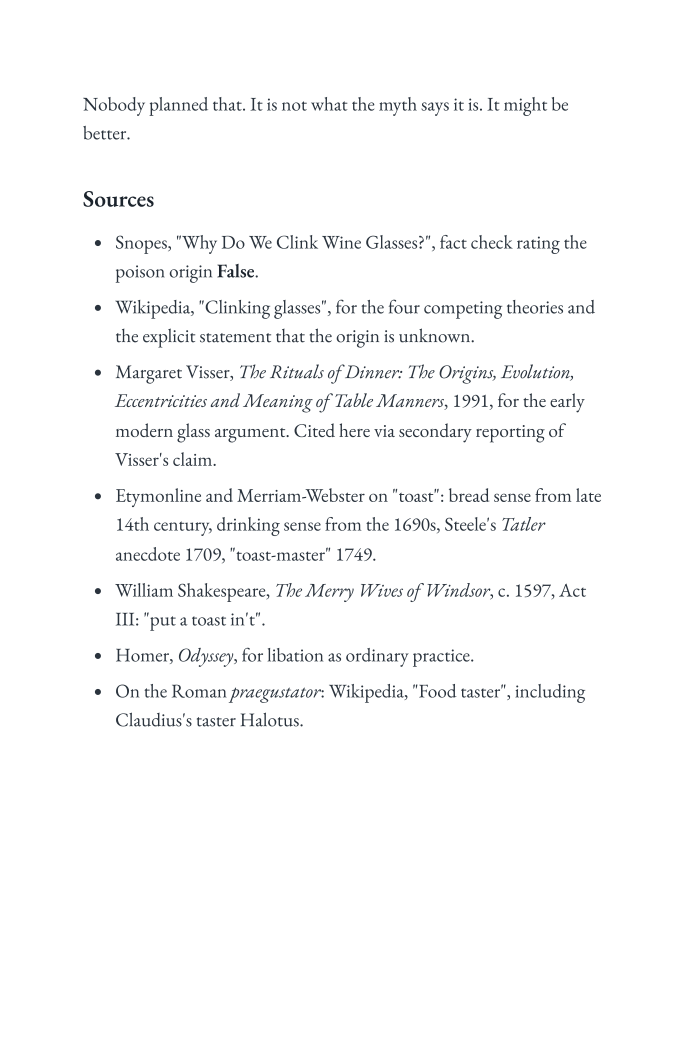
Clinking glasses, the fork that took six hundred years, salt and pepper and nothing else, three meals a day, fire on a cake, tipping, popcorn.
9 entries

in the body

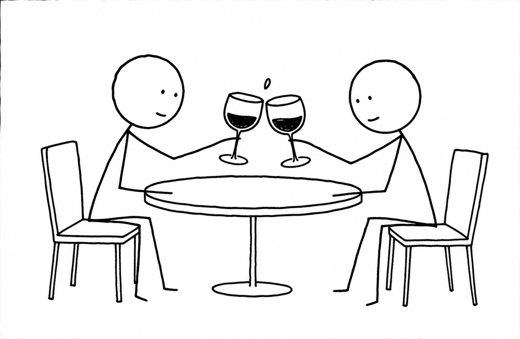
Your own voice, contagious yawning, crying, why you cannot tickle yourself, hiccups, goosebumps from music, sneezing at the sun, sighing, blushing.
10 entries

among others

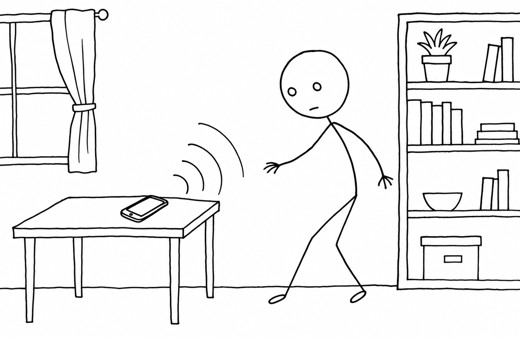
Shaking hands, whispering in libraries, clapping, nobody smiling in old photographs, the weather, forgetting a name in four seconds, queues, lifts, laughing, standing on the right.
6 entries

in the house

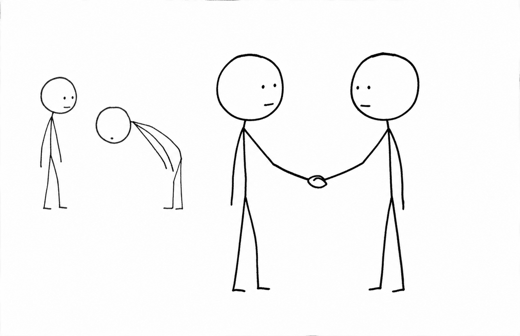
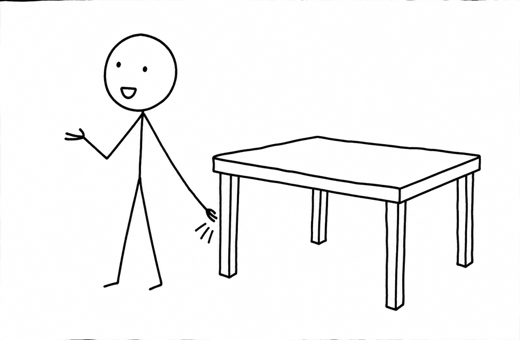
Knocking on wood, forgetting why you came in, the corridor, the lawn, the room nobody sits in, the photographs you will never look at again.
10 entries

things we built & things we say

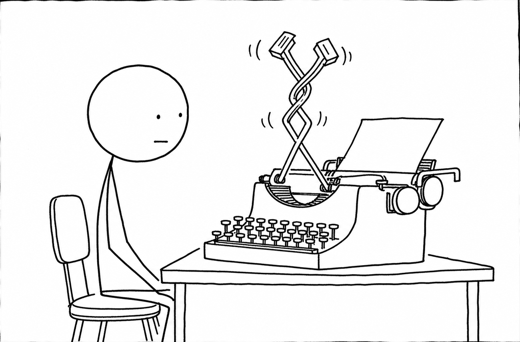
The mess of your keyboard, why clocks turn that way, why red means stop. Then: bless you, hello, OK, long goodbyes, um, swearing, baby talk.
8 entries

after dark

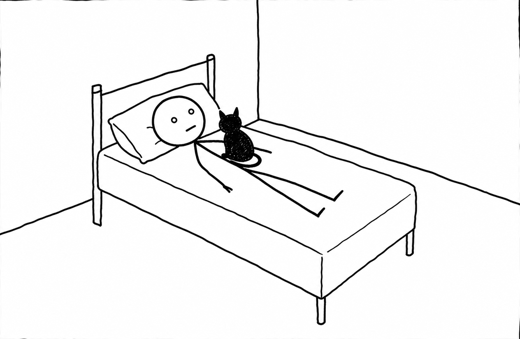
Why the dark feels different, the thing sitting on your chest, waking at three, the phone, the song that will not leave, why you cannot remember being two, why the years keep getting shorter.


Look inside

real pages from the book

Set like a book, not like a blog post. A drawing for every entry, and the sources under each one.

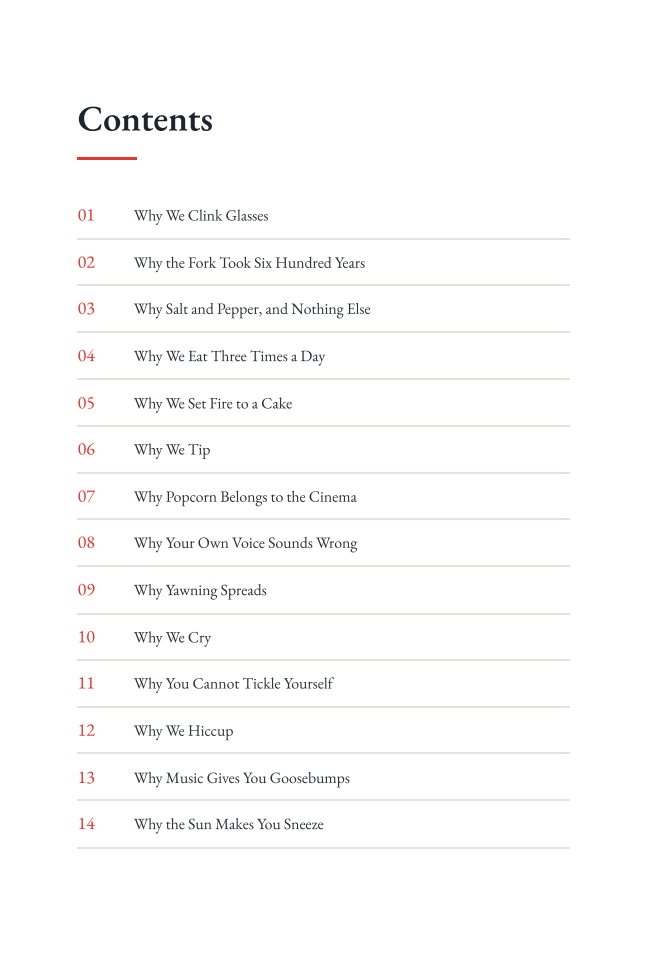
Contents page
All 50 entries, dip in anywhere
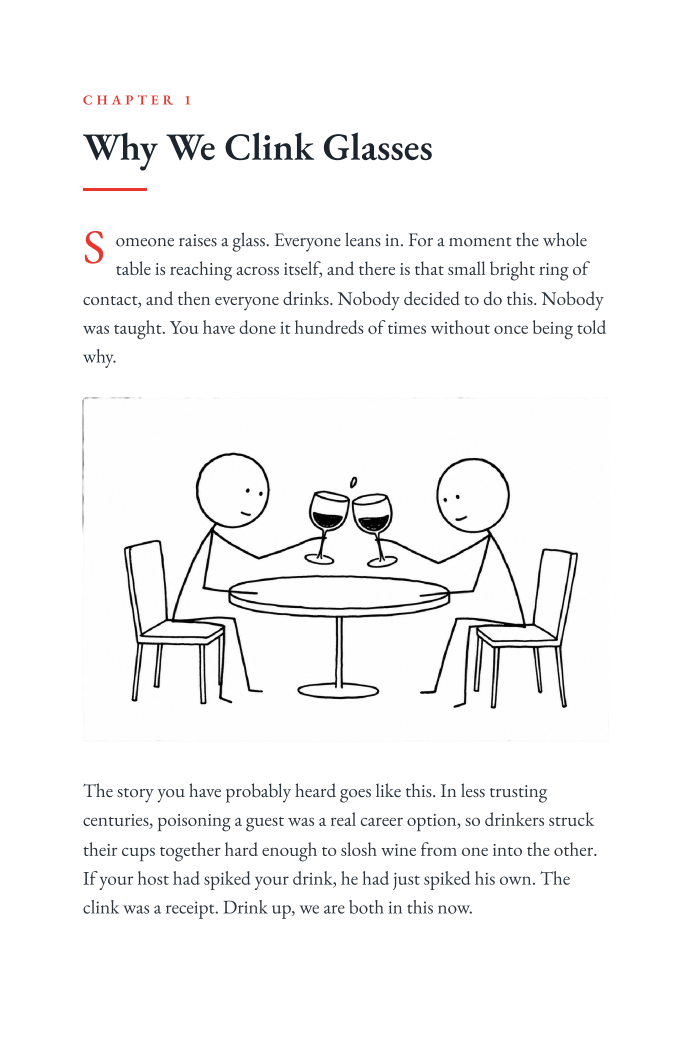
The opening of Why We Clink Glasses
Every entry opens with the habit itself
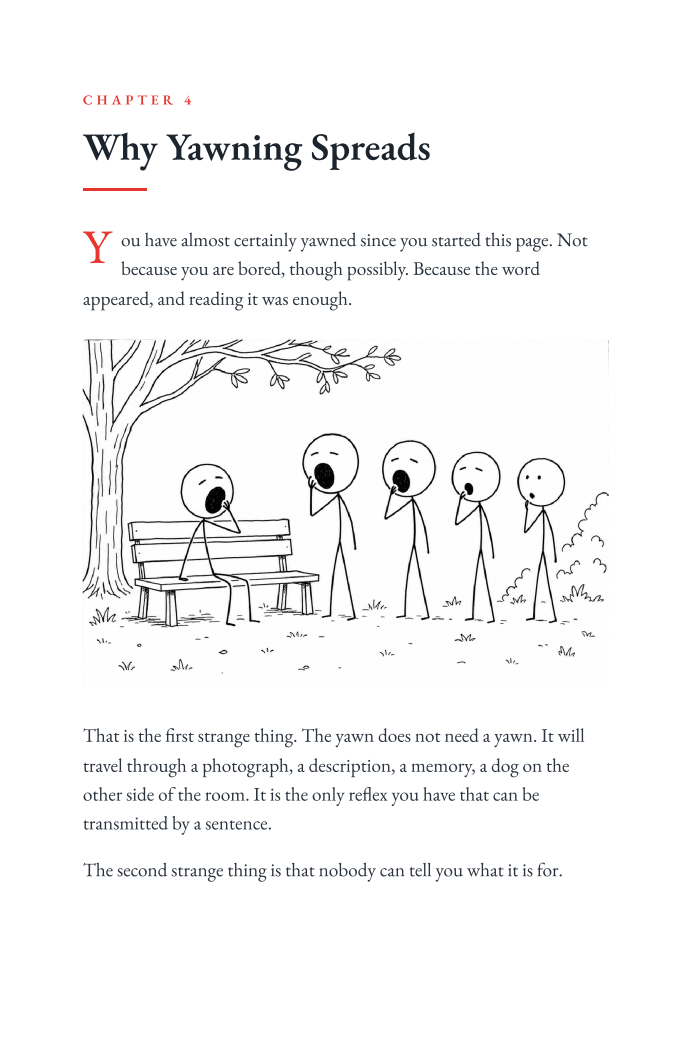
The opening of Why Yawning Spreads
And a drawing, all 50 of them
A sources list at the end of an entry
Then the sources. Go and check us.

Read five entries free (PDF)

Why this one is different

trivia books don’t show their work

Go and read the reviews of the ones already on the shelf. The same complaints come back every time: no sources, copied from the internet, charming stories that turn out to be invented, and no way to tell which is which.

That is the whole reason this book exists, and it is the one promise it makes:

  • Every entry ends with its sources, named, so you can go and check
  • Where a claim comes second-hand, it says so instead of pretending
  • Where the evidence is thin or contested, it says that too
  • Where nobody knows, it says nobody knows, and stops

One entry was researched, written, and then cut, because the only things backing it up were blogs quoting each other. It is not in the book. That is the standard.

A sources list from the end of an entry
All fifty

the full list

Two to three pages each. This is the whole book.

From the book

in its own words

“We spend our lives fairly certain we are sealed units. Then somebody yawns on a train, and eleven strangers quietly prove otherwise.”

Why Yawning Spreads

“A wage is an obligation on a company. A tip is a feeling in a customer. Somewhere in the 1870s, someone worked out that the second one is much cheaper, and we have been calling it kindness ever since.”

Why We Tip

“The voice is fine. It is a perfectly good voice. What ruins it is the label. The moment you know it is you, you are not listening to a sound, you are auditing a self.”

Why Your Own Voice Sounds Wrong
Questions

good to know

Can I read some of it before buying?

Yes. Five complete entries, including the sources, are free: download the sample PDF. If it is not your kind of thing, don’t buy it.

What do I actually get?

A 182-page PDF, set at 6×9″ like a real book, with 50 entries and 50 drawings. It works on a phone, a tablet, a computer, or printed out. Instant download after purchase.

Is this AI slop?

Fair question, and the honest answer is in the sources. Every entry was researched against primary sources where they exist, and the citations are printed so you can check them yourself. Where the research came second-hand, the entry says so. One entry was cut entirely because the only support for it was blogs quoting each other. AI tools were used in making this book; that is exactly why every claim is sourced rather than asserted.

Do I need to read it in order?

No, and most people won’t. Each entry stands alone in two or three pages. It is built to be opened anywhere, which is also the honest way to read it: a few at a time is better than fifty in one sitting.

Who is it for?

People who ask why, and people who are hard to buy presents for. If someone in your life has ever derailed a dinner by asking where a word came from, this is aimed squarely at them.

Refunds?

It is a digital download, so the statutory right of withdrawal ends once the download starts, and you agree to that at checkout. That is why the sample is five full entries rather than a teaser: see what it is before you pay for it.

Get the book

fifty answers, sources included

The things you do every day without asking, explained properly.
  • All 50 entries, 182 pages, PDF
  • A drawing for every entry
  • Sources under every entry
  • Reads on phone, tablet, desktop or paper
  • Yours forever, no subscription
€9,99
one-time · instant download
Get the book · €9,99
Coming this week.